
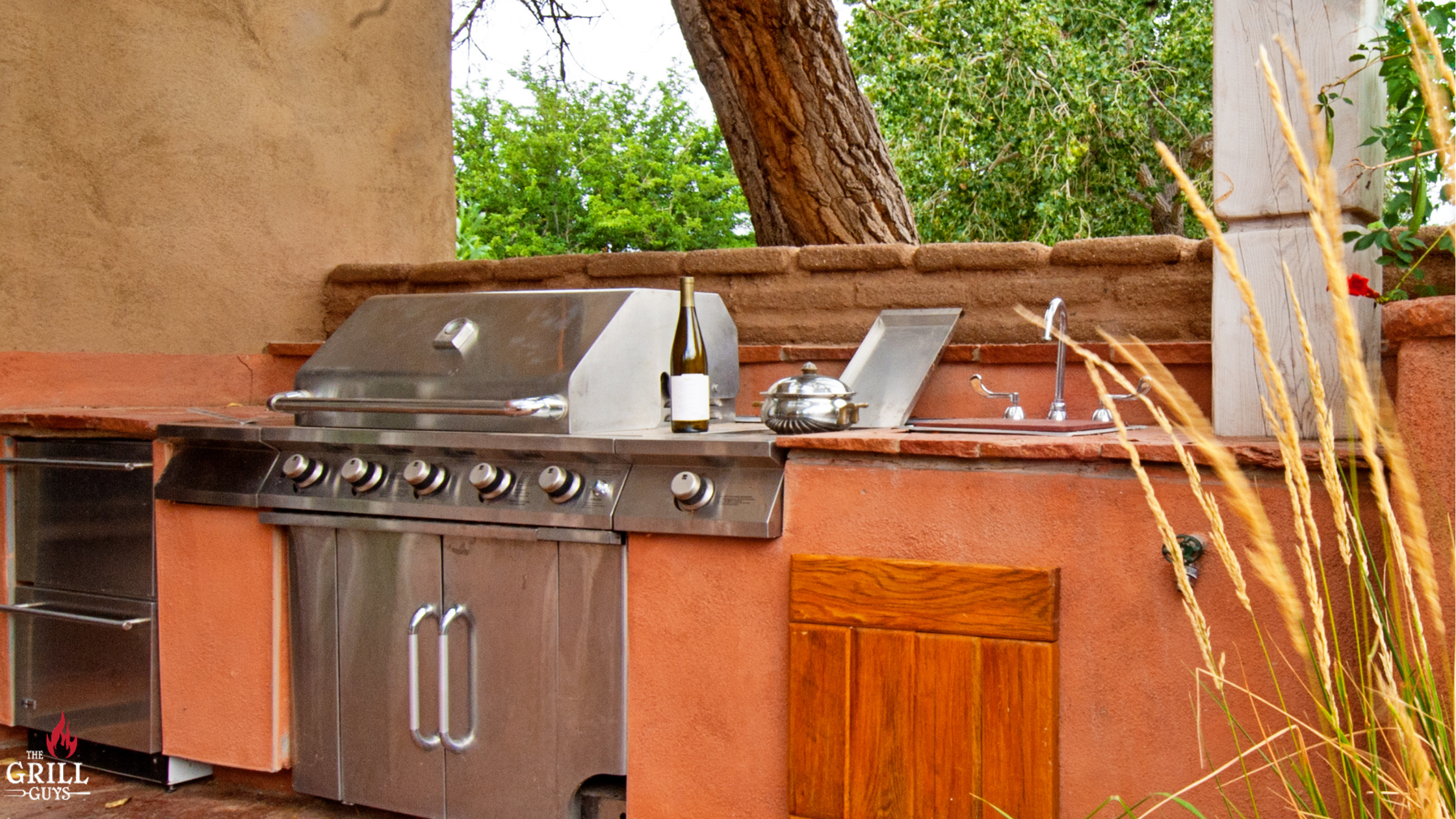
Outdoor kitchen repair becomes a really expensive problem the moment you realize it could have been prevented. You drop $35,000 on a built-in kitchen with a Lynx or DCS grill. It looks bulletproof.
Then one summer, the burner manifold starts corroding, the ignition module quits right before guests arrive, or a hard-water deposit quietly eats through the cabinet frame. At the same time, you’re busy using the kitchen. By the time you see the damage, the bill is already waiting.
This guide covers what actually fails on high-end outdoor kitchens, what professional maintenance catches before it turns into a repair call, and why the math on a maintenance program beats emergency service costs for any outdoor kitchen worth protecting.
Key Takeaways
- Ignition systems are the first thing to fail on a premium built-in grill. Electrode replacement typically runs $200–$500 on a Lynx, DCS, or Fire Magic unit — catching the problem early keeps it a parts swap, not a module replacement.
- Heat plates, burners, and grease-management systems fail in sequence — not in isolation. A neglected $45 drain channel cleaning can compound into a $400 manifold repair when the failure chain goes undetected.
- Gas grill fires are not rare: the NFPA documents an average of 9,235 home grill fires per year. Grease system blockage is a direct contributor — cleaning it is a safety issue, not just a maintenance preference.
- Texas conditions accelerate wear faster than most of the country. Year-round use, 95°F+ summers, hard water mineral scale, Gulf Coast humidity, and spring pollen all combine to degrade burner ports, ignition modules, and gas fittings between service visits.
- A single-component repair on a premium built-in runs $150–$500; a multi-failure repair call runs $500–$1,500. A professional service visit that catches developing problems runs $150–$315 — the math favors maintenance.
- Stainless steel does not mean maintenance-free. Even 304-grade stainless on a $35,000+ outdoor kitchen corrodes at weld seams and horizontal surfaces under Houston humidity — surface pitting caught early is a straightforward fix; pitting that reaches the substrate is not.
What Outdoor Kitchens Are Actually Made Of (And Why That Matters for Repair)
A lot of homeowners assume stainless steel means set it and forget it. It doesn’t work that way.
304 stainless steel, the commercial kitchen standard used on most premium built-in grills from Lynx, DCS, Fire Magic, and Twin Eagles, holds up well under normal conditions. But Texas heat, coastal humidity, high-mineral well water, and the grease-and-ash environment right around the cooking surface all work together to accelerate corrosion on every stainless component you’ve got; burners, crossovers, heat plates, cooking grates, flash tubes, the cabinet framing, all of it.
Every grill brand uses different grades and gauges of stainless steel. Some use higher-grade alloys, like marine-grade stainless, and some use heavier-gauge material. That adds durability and definitely adds cost, but it does not make the grill immune to the elements. Every component in a built-in outdoor kitchen sits outside year-round, 365 days, 24 hours per day, exposed to heat, humidity, rain, grease, carbon buildup, and constant thermal stress.
The parts that fail and the sequence in which they tend to fail matter a lot for understanding what outdoor kitchen repair actually costs and why staying ahead of it with professional maintenance makes financial sense.
The 6 Components Most Likely to Need Outdoor Kitchen Repair
Ignition Systems
Think about it this way: the ignition electrodes and some of the other ignition parts are the smallest exposed parts on a gas grill. It makes sense that these parts will fail the quickest. The electronic ignition on a Lynx or Fire Magic isn’t the same system you’d find in a $500 big-box grill or even a mid-level gas grill. The components are built to a higher standard, but they also require more labor to replace when something goes wrong.
What to watch for: clicking with no ignition, no spark at all, or ignition that only works on some burners. Electrode replacement usually fixes it. If the module itself has failed, you’re looking at $200–$500 for replacement on a high-end unit, depending on the brand and parts availability. Your technician will be able to confirm the exact pricing for you.
Heat Plates, Heat Shields, Flame Tamers, or Flavorizer Bars
These are the parts that handle the most abuse as they sit directly under the cooking grates and directly above the burners. Their functions are to:
- Protect the burners. They sit above the burners and help keep grease, marinades, food debris, and drippings from falling directly into the burner ports.
- Reduce flare-ups. When grease hits the shield instead of the open flame, it helps control sudden flare-ups and makes the grill safer and easier to cook on.
- Spread heat more evenly. They help distribute burner heat across the cooking surface instead of having narrow hot strips directly over each burner.
- Vaporize drippings for flavor. Grease and juices hit the hot metal, vaporize, and rise back toward the food. This is part of what gives gas grilling that grilled flavor.
- Prevent direct flame contact. They act as a barrier between the burner flame and the food, helping reduce scorching spots.
- Support better temperature control. By evening out the heat and reducing flare-ups, they help the grill hold a steadier cooking temperature.
- Extend burner life. By shielding burners from grease, salt, acids, carbon buildup, and moisture, they can help burners last longer.
To do all this, they must be exposed to all of the bad things that corrode them, making them items that wear out fairly quickly without proper maintenance.
Burners
Burners take a lot of abuse, too. Grease, moisture, insects, and carbon buildup can clog the burner ports and restrict airflow over time. Crossover sections, which allow flame to carry from one burner to the next, often corrode first because they sit low in the burner assembly, right where moisture and condensation tend to settle.
What to watch for: an uneven flame pattern, a burner zone that will not light, or a flashback “whoosh” sound when the burner is turned on. On a premium built-in grill, cleaning the burner ports can often solve the problem if it is caught early. If the damage has gone further, the repair may require replacing the crossover section or the full burner tube.
Depending on the brand and how intricate the repair is, it can run $150–$400 per burner. Fire Magic grills actually suggest a burner soak every few years to keep them working at their peak performance.
Grease Management Systems
Most built-in gas grills have some type of grease-management system, whether it is a drip tray, drain channel, collection cup, slide-out pan, or removable liner. When those parts go too long without service, grease builds up, hardens, and can eventually block the drainage path. At that point, the concern is not just dirty burners; it is pooled grease underneath the cooking surface that can ignite during normal use.
According to the NFPA, gas grills are involved in an average of 9,235 home fires per year, including 4,662 structure fires and 4,573 outdoor fires. That is why keeping the grease system clean is not just about appearance; it is a real safety issue.
What to watch for: grease weeping around the base of the grill, smoke coming from below the grates during cooking, or visible buildup in the drip pan that no longer wipes away easily. A full grease-system cleaning should be part of any professional grill service. Light grease can sometimes be handled by the homeowner, but grease that has baked onto surfaces for months often requires proper tools, safe disassembly, and commercial-grade degreasers to remove it correctly.
Gas Valves and Flex Lines
Built-in grills depend on more than burners and stainless steel. They also rely on a properly installed gas supply, shutoff valve, regulator when required, flex connector, fittings, and control valves. Those parts live in a tough environment, and over time, age, heat, moisture, corrosion, movement, and normal use can all take a toll.
A cracked, kinked, corroded, or leaking gas connector is not a minor issue. It is a safety concern that needs to be addressed immediately. High-BTU grills put even more demand on the system. A premium built-in can have burners rated at 20,000 to 25,000 BTU each, and infrared sear burners can run in that same range.
That kind of heat, combined with outdoor exposure and years of use, can wear on valves, fittings, and internal gas components. Valve stems can get stiff, seats can wear, and small leaks can develop slowly over time. What to watch for: a gas smell anywhere near the grill, a valve that feels stiff or rough when you turn it, a burner that seems weaker than it used to be, or any connector that looks cracked, kinked, rusted, or worn.
Flex connector or hose replacement is usually a straightforward repair when the problem is caught early. Valve replacement on a built-in grill is more involved and should be handled by someone qualified to work on gas appliances. This is not something to guess at or attempt without the right tools, leak testing, and gas-safety knowledge.
Side Burners, Infrared Burners, and Rotisserie Systems
Most premium outdoor kitchens have more to maintain than just the main grill. Side burners, infrared sear zones, rotisserie systems, pizza oven inserts, smoker drawers, and other accessories all add convenience, but they also add more parts that can wear out. Each one has its own burner assembly, ignition components, gas connections, and failure points.
Rotisserie motors can seize when they sit unused or go too long without maintenance. Infrared burner screens can crack if cold water hits them while they are still hot. Side burner valves can get stiff or corroded after months of sitting unused between gatherings. All of these parts are expensive to replace. Most of them are much less expensive to maintain.
What Texas Weather Does to Outdoor Kitchens Year-Round
Texas outdoor kitchens do not get much of an off-season. In Houston, Katy, Memorial, Sugar Land, The Woodlands, River Oaks, West U, Bellaire, Tanglewood, Oak Forest, and the surrounding areas, people grill year-round. That is one of the main reasons they build an outdoor kitchen in the first place.
But year-round use also means the grill, burners, ignition system, valves, and grease-management system never get the seasonal break that grills in colder climates often get. Texas weather adds its own set of problems.
Summer heat is one of the biggest. When the outside temperature is already above 95°F, and the grill is adding radiant heat from the cooking surface, the stress on burner joints, valve seals, ignition wiring, and internal components can be significant during a long weekend cookout. Over time, that kind of sustained heat can accelerate wear long before the problem is obvious.
Humidity and hard water make things worse. Houston-area water has enough mineral content to leave scale behind on the surfaces it touches. When that mineral buildup mixes with grease, carbon, and cooking residue inside drip trays, drain channels, burner ports, and other tight areas, it becomes much harder to remove than ordinary grease alone.
Storm season adds moisture where you do not want it. A covered patio may keep direct rain off the grill, but Gulf Coast humidity still finds its way into fittings, seals, electrode gaps, ignition modules, and control areas. After months of exposure, that moisture can lead to weak spark, intermittent ignition, corroded connections, or burners that stop lighting reliably.
Then there is pollen season, which surprises a lot of homeowners. In Texas, spring pollen can collect quickly on grills that sit unused for even a few weeks. A grill that looked clean in February can have clogged burner ports, dirty air openings, and ignition issues by mid-March.
That is why outdoor kitchens in this climate need regular maintenance, not just occasional cleaning when something stops working.
The Real Cost of Skipping Outdoor Kitchen Repair
The math is pretty simple once you lay it out.
A professional BBQ grill repair on a single component–one burner tube, one ignition module, one valve–runs $150–$500 depending on the brand and part. If multiple components fail at the same time, which happens when deferred maintenance lets problems compound, a full repair call runs $500–$1,500 in parts and labor. Add the scheduling delay during peak season, and it gets more painful.
A professional grill cleaning service that catches developing problems before they become failures runs $150–$315 for a standard visit. The technician finds the cracked burner port, the corroding flex connector, the seized door hinge–before the part fails. That’s the value of the visit.
Deferred maintenance on a $25,000–$75,000 outdoor kitchen doesn’t save money. It converts $200 problems into $800 problems.
The failure sequence is what makes this expensive. Grease management failure leads to burner port blockage. Burner port blockage leads to uneven combustion. Uneven combustion puts thermal stress on the manifold. What started as a $45 drain channel cleaning became a $400 manifold repair because nobody caught the chain early enough.
Why Professional Maintenance Catches What Owners May Miss
When you clean your own outdoor kitchen, you can see what’s in front of you–surface grease, buildup on the grates, the obvious stuff. A trained grill technician looks at what isn’t in front of you: the flex line condition, the electrode gap, the burner port blockage pattern that tells an experienced eye which burner is headed for failure next, the mineral scale in the grease drain that’s two months away from becoming a drainage problem.
The Grill Guys technicians–Anthony, Frederick, Daniel, Alex, and the rest of the team–have worked on every major premium grill brand across Texas. They know what a Lynx burner tube looks like at six months versus 18 months. They can read a DCS ignition electrode and tell you whether it’s fine or close to the end. That diagnostic accuracy comes from thousands of service visits–the kind of pattern recognition that an annual homeowner inspection just can’t replicate.
The inspection piece of a professional service visit isn’t a formality; they don’t fill out paperwork. For an outdoor kitchen owner with real money invested, it’s the most valuable part of the visit.
The Maintenance Program: Built for Outdoor Kitchen Owners
The grill maintenance program was built for exactly this situation–a high-value outdoor kitchen that needs consistent professional attention, not a cleaning call whenever something finally looks bad enough to deal with.
Think of the program as the always-on insurance layer for a $25K–$75K build. Texas humidity, pollen, hard-water deposits, and the compound stress of year-round cooking all accumulate over the year. Quarterly professional service catches what’s built up before it becomes a failure.
For outdoor kitchen owners specifically, the program math is even more favorable than it is for a standard grill. More components mean more failure points. More failure points mean more repair calls–unless a professional is checking in regularly and catching developing problems before they materialize.
What the program delivers for outdoor kitchen owners:
- Priority scheduling. No waiting on hold during the peak summer season, when everyone needs service at the same time
- Consistent technician. The same tech learns your specific kitchen, what’s been replaced, and what to watch
- Component history. A running record of what’s been serviced and when, so nothing gets missed
- Honest assessments every visit. If something needs repair, that’s what’s recommended, not a cleaning that buys a few more weeks before the real problem surfaces
No upsell pressure. If the kitchen is in good shape, the visit confirms that. If something needs attention, the assessment is specific and honest about what’s urgent versus what can wait.
Frequently Asked Questions About Outdoor Kitchen Repair and Maintenance
Grill Cleaning Frequency by Type
Is it worth repairing my outdoor kitchen, or should I just replace it?
Almost always worth repairing on a premium brand. A Lynx, DCS, or Fire Magic built-in is designed for 15–20+ years, and the components that fail most often are relatively cheap to replace. The honest answer depends on what’s actually wrong, which is why the technician assesses the kitchen and gives a price before any work starts.
My outdoor kitchen grill won't light. What's actually wrong with it?
Usually one of three things: a corroded electrode tip, moisture in the ignition module, or a clogged crossover igniter port. What looks like a dead grill is often a straightforward fix once it’s diagnosed on-site.
How do I know if my outdoor kitchen grill has a gas leak?
Smell gas near the unit with the valves closed, notice a stiff or rough valve, or run the soapy water test on the fittings; bubbles mean a leak. Any of those signs warrants a professional inspection before the unit is used again.
Why does my outdoor kitchen grill have uneven flames?
Nine times out of 10, it’s blocked burner ports–grease, mineral scale, carbon buildup, and Texas spring pollen all clog the small ports along the burner tube. It’s a maintenance issue, not a replacement issue, but it needs professional degreasers and port cleaning tools to fix properly.
How often should a built-in outdoor kitchen be cleaned and serviced in Texas?
Quarterly for an actively used kitchen–year-round Texas use combined with summer heat, hard water, and Gulf Coast humidity means problems compound faster here than most of the country. Twice-yearly is the minimum for a lower-use kitchen.
Can I clean my outdoor kitchen myself, or does it need a professional?
Surface cleaning–wiping the exterior, scrubbing grates, emptying the drip pan–is fine to do yourself. Everything underneath (burner ports, gas connections, ignition system, grease drainage) needs professional disassembly, commercial-grade degreasers, and diagnostic experience to do safely.
What's the difference between a one-time outdoor kitchen cleaning and a maintenance program?
A one-time cleaning addresses what’s there right now; a maintenance program catches what’s developing before it fails. For a $25,000–$75,000 outdoor kitchen with multiple components, the program also means a technician who knows the specific kitchen, priority scheduling during peak season, and a running component history.
Does stainless steel on a built-in outdoor kitchen rust?
Yes, eventually–weld seams and horizontal surfaces are vulnerable even on 304 stainless, especially in Houston’s humidity and coastal salt air. Surface pitting caught early is a straightforward treatment; pitting that’s allowed to reach the substrate is a much bigger problem.
How much does outdoor kitchen repair cost in Texas?
Single-component repairs run $150–$500; a full repair call with multiple simultaneous failures can reach $500–$1,500 or more. A professional service visit that catches a developing problem early runs $150–$315. (Confirm current pricing when you call–parts costs vary by brand.)
Does The Grill Guys USA service outdoor kitchens that they didn't install?
Yes–brand, installer, age, and current condition don’t matter. The technician assesses on arrival and gives a specific price before work starts; if something isn’t worth fixing, that’s what they’ll say.
What should I look for when hiring someone for outdoor kitchen repair?
Experience with premium built-in brands specifically, a clear diagnosis and price before work begins, and verified BBB accreditation — premium outdoor kitchen repair is an area where unqualified contractors can cause more damage than they fix.
Protecting Your Luxury Grill Investment
Outdoor kitchen repair gets expensive when it takes the place of maintenance that never happened. The built-in kitchen in the backyard of a Katy or Memorial home is a serious investment in how you live–one that holds up for 15–20 years with the right care, or starts generating repair bills without it.
The Grill Guys USA team services outdoor kitchens across Texas and greater Houston with the technical expertise to keep premium equipment running right and the honesty to tell the difference between what needs attention now and what can wait.
Join the maintenance program and get the first visit on the calendar. The kitchen gets inspected, serviced, and ready before the next issue has a chance to turn into an outdoor kitchen repair call.
Not all grills are created equal, not all grill parts are created equal and not all grill service companies are created equal. You might have a $650.00 grill that lasts you 25 years and you might have an $8,000.00 grill that lasts you 4 years. The factors listed above will contribute to the life of the grill, but maintaining the grill is the single most important part in the longevity of an outdoor grill. We are not perfect in what we do, but we strive to be and we strive to be the most transparent, fairest company out there.
About the Author
Tony Thomas is the co-owner of The Grill Guys USA, a BBB A+ accredited (since May 2023) and BBB Winner of Distinction grill cleaning and repair company. Tony founded the company in 2020 with two high school friends who shared a passion for outdoor cooking, and has spent the last six years building Texas’s premier mobile grill restoration service. Tony and his team built a cleaning system that brings professional-grade grill restoration directly to customers’ homes in Greater Houston, Austin, San Antonio, the Hill Country, College Station, and Lubbock. The Grill Guys USA is a partner of many grill manufacturers.